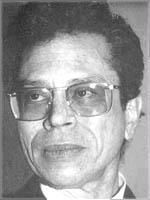
Leo Brouwer was born in Havana, Cuba in 1939. When he was 13, he began to study classical guitar with the encouragement of his father, who was an amateur guitarist. His teacher was Isaac Nicola, a student of Emilio Pujol, who was himself a student of Francisco Tárrega. At age 17 he performed publicly for the first time and began composing. He traveled to the United States to study music at the Hartt College of Music at the University of Hartford, and later at Juilliard, where he studied under Vincent Persichetti and took composition classes with Stefan Wolpe.
In 1970 Brouwer played at the premiere of El Cimarrón by Hans Werner Henze in Berlin. Together with Morton Feldman, he was awarded a 1972 scholarship by the DAAD (German Academic Exchange Service) to work as a guest composer and lecturer at the Academy of Sciences and Arts of Berlin. In Germany, Brouwer also recorded a number of LPs for Deutsche Grammophon.
In his early compositions, Brouwer remained close to the rhythms of Cuban music, while later he was drawn to aleatoric music. During the 1960s and 70s, he became interested in the music of modernist composers such as Luigi Nono and Iannis Xenakis, using indeterminacy in works such as Sonograma I. Other works from this period include the guitar pieces Canticum (1968), La espiral eterna (1971), Parábola (1973) and Tarantos (1974). More recently, Brouwer's works have leaned towards tonality and modality. The solo guitar works El Decamerón Negro (1981), Paisaje cubano con campanas (1986), and the Sonata (1990; for Julian Bream) exemplify this tendency. His playing career ended in the early 1980s due to a tendon injury in his right hand.
Brouwer has written for guitar, piano, and percussion, and has composed orchestral works, ballet music, and music for over one hundred movies, including the film Like Water for Chocolate. For a guitar competition in Hungary in 1979, he wrote a composition that employed 200 guitarists. He is known for a series of studies called the Etudes Simples. Brouwer has also transcribed Beatles songs for classical guitar.
He has performed and recorded works by Sylvano Bussotti, Hans Werner Henze, Maurice Ohana, Cristóbal Halffter, Leni Alexander, Cornelius Cardew, and Heitor Villa-Lobos.
Brouwer has held conducting positions with a number of symphony orchestras, including the BBC Concert Orchestra, the Berlin Philharmonic, and the Córdoba Symphony in Spain. He is active in Havana International Guitar Festival and Competition. He frequently travels to attend guitar festivals around the world, and especially to other Latin American countries. According to the composer himself, he has never been a member of the Communist Party of Cuba, but has nevertheless held a number of official posts in Cuba, including some with the music department of the Cuban Institute of Cinematographic Art and Industry.
In the Concierto Elegíaco, his third guitar concerto, he evidences a deep and intense lyricism. In the first movement this is made all the more poignant by the interplay of the guitar's melancholy and pensive themes with the orchestra's more tragic motif of two ascending and two descending half-steps. The second movement is really a long guitar cadenza that elaborates on the ascending and descending notes played by the orchestra in the first movement, it serves as a short interlude, and it leads into a fast-paced third movement entitled Toccata. Brouwer wrote this concerto for strings plus timpani and a second percussionist playing glockenspiel, marimba, tom toms and side drum. A superb orchestrator, he makes this small group sound much larger than it really is, while maintaining a comfortable balance with the guitar.
He is the grandson of Cuban composer Ernestina Lecuona y Casado. His great-uncle, Ernesto Lecuona, composed La Malagueña and his second cousin, Margarita Lecuona, composed Babalú, which was popularized by Cuban musician and actor Desi Arnaz. Brouwer is the great-uncle of Al Jourgensen of Ministry fame. He is the brother of Jourgensen's maternal grandfather. He has five children.
Some of the content in this biographical note is reproduced from Wikipedia.